Anthropomorphism: Seeing Personality, Finding Ourselves — Part 2
Personality is a word we use often when describing the animals we love—but what do we really mean when we say it? In this post, I explore how personality, projection, and connection shape the human–animal bond—and the questions that emerge when we begin to look more closely.


As a qualitative researcher, I have to be sensitive to what emerges. While not explicitly identified as a theme, I noticed a common word among pet parents in my research: personality. Some described their pet’s personality using specific traits (e.g., charismatic), others spoke about their pets as having personalities similar to their own, and some even used the idea of personality as a way to challenge the belief that pets do not have souls.
These human-centered interpretations sit at the heart of how many people experience the human–animal bond.
For Part 2 of the anthropomorphism blog series, I'm going to take a closer look at the idea of personality and the connection to anthropomorphism, specifically considering:
How do we understand personality in the context of the human–animal bond?
Because for many of us, the animals we love are not just present in our lives—they are distinct. They are expressive. They are, in many ways, full of personality.
What Do We Mean by Personality?
Most definitions of personality come from psychology and are centered on humans. For example, personality is often described as a person’s distinctive patterns of thinking, feeling, and behaving, shaped by both innate tendencies and life experiences. Similarly, the American Psychological Association defines personality as a configuration of characteristics and behaviors that make up an individual’s unique way of adjusting to life.
Within these definitions, there is an underlying assumption that personality belongs to a person. The word itself points us in that direction. But when we think about the animals in our lives, many of us instinctively extend that same language to them through the patterns we observe, the traits we assign, and the differences we recognize.
We might say our dog is curious, another is independent, our cat is affectionate, or our ferret is mischievous. We also think about compatibility and connection in how well an animal’s “personality” fits with our own. Animal shelters and adoption spaces draw on this in subtle ways, often encouraging time spent “building rapport” with an animal before they come home with us.
So the question becomes not just what is personality, but what we mean when we use that word beyond its traditional, human-centered definition.
Personality in Practice
For many of us, the idea of personality doesn’t come from theory—it comes from experience.
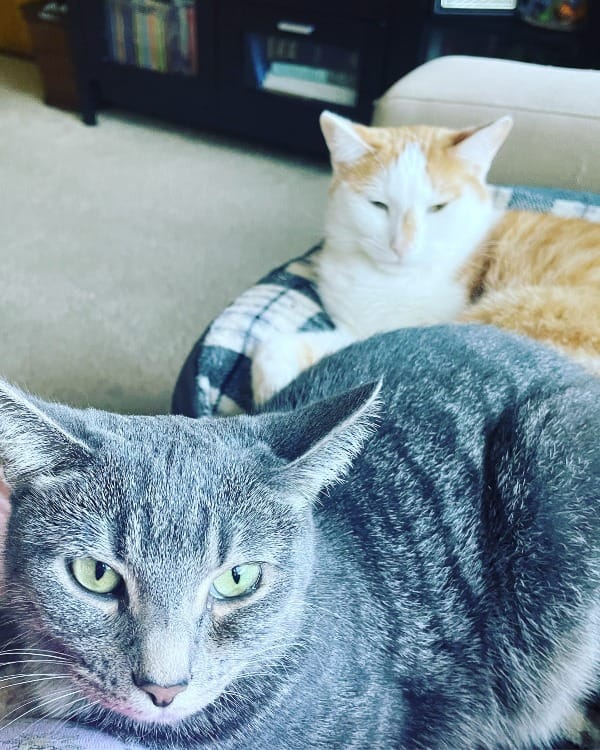
In truth, my cats, Tina and Joe were part of a three-kitten litter. The third kitten, their sister, was so feisty and fast that, at the time, I didn’t feel like she aligned with my lifestyle. Tina and Joe were more easygoing, so I "chose" them. Even the volunteer coordinator at the shelter I adopted them from said that the third kitten shouldn't have any problems getting adopted by a more active family (I didn't take offense because I got what they were saying). In that moment, there was a sense of compatibility and choosing not just a pet, but a personality. And in doing so, we begin to relate to our pets, not just as animals, but as individuals.
Joe is curious and a little mischievous, but also sensitive. He startles easily, doesn’t always like to be touched, and tends to engage on his own terms. Tina, on the other hand, carries herself differently. She moves through the house like she owns it—confident, expressive, and, at times, a bit dramatic. She’ll fuss when she’s annoyed and has no problem letting her brother know when he’s crossed a line.
But there’s another layer to how I describe them both.
I often use the word “anxious.” When I think about why, it comes back to how they respond to their environment—jumping at unexpected noises, pulling away from unfamiliar interactions, not being particularly fond of people. Part of me connects those behaviors to their early experiences, wondering if they were separated from their cat mother too soon or exposed to something that shaped how they move through the world.
But even as I say that, I have to pause because that is my human interpretation.
Anxiety and trauma are part of my story. While I do believe there is truth in describing Joe as mischievous or Tina as confident, I also have to question what happens when I assign something like “anxiety” to them. And who’s to say that their sister that I left behind wouldn’t have developed in similar ways? Sometimes, I wonder if I’m trying to explain away something that is meant to remain a mystery just to soothe something within myself.
We often recognize this kind of projection in human relationships. But when it comes to our animals, the line feels less clear.
From Anthropomorphism to Personality
This all connects back to that big word: anthropomorphism.
In my previous post, I explored how we attribute human qualities, such as emotions, thoughts, and intentions, to the animals in our lives. But one of the natural extensions of that process is personality. We don’t just interpret what our animals feel, but we begin to describe who they are.
What I’ve come to understand, both through research and experience, is that people create imaginative stories about their animals’ thoughts, behaviors, and even identities—not only as a way to understand them, but also as a way to understand themselves. In doing so, we may move beyond the animal’s inherent nature and begin to shape a narrative that reflects human ways of being.
We give them preferences.
We give them roles.
We give them identities.
And over time, those identities begin to feel real, not just as stories we tell, but as truths we experience. This goes beyond my cat Samson going to school taught by birds. This is Samson’s sassiness getting him in trouble with his bird teachers.
In my research, the word "personality" came up often. Participants described their pets as having distinct, recognizable traits—charismatic, independent, affectionate, even “just like me.” One participant shared about her dog that she had to put down:
“Like, I'm kind of funny about who I associate with. He [her dog] had that same persnickety type of personality. He was real funny about food. I'm funny about food.”
For many, these descriptions were deeply emotional, reflecting not just observation but connection. Their animals were not interchangeable. They were specific, known, and understood in ways that felt personal. This is also part of why some people struggle with the word "pet,"* and why terms like "companion animal" or "animal companion" have gained traction over time.
The same qualities that draw us to people—familiarity, compatibility, emotional resonance—are often what we recognize in our animals. We notice what feels aligned and meaningful. And through that recognition, we begin to relate, attach and understand our animals. not just through what they do, but through who we believe them to be.
When Personality Deepens Loss
There is both beauty and tension in this.
On one hand, recognizing personality in the animals we love can deepen connection in meaningful ways. It allows us to relate, to feel closeness, and to experience companionship that feels personal rather than abstract. Personality gives shape to the bond and makes the relationship feel specific.
It also allows for joy. For play. For storytelling. For connection that feels alive and responsive.
But on the other hand, something more complex is happening.
The more we attribute human personality to our animals, the more we may begin to center on our own interpretations of who they are. We may start to see them through a lens shaped by our needs, our emotions, and our ways of understanding the world. That interpretation can bring comfort to us, but what does it do for the animal's experience?
This also brings grief into sharper focus.
When an animal is humanized and not just seen as a pet, but as a friend, a child, or a source of emotional support, and their personality feels known and familiar, the loss can feel profound. It is not simply the absence of an animal. It is the loss of someone we understood...dare I say, as a person.
Irreplaceable.
In some cases, this can also shape how people experience difficult decisions, such as euthanasia. When an animal is understood through the lens of human personality and identity, that decision can carry a moral and emotional weight that is difficult to put into words and intensify the complexity of grief.
In the next post, I will explore how anthropomorphism and personality shape attachment—and how that attachment influences the way we experience grief after the loss of a pet.
But for all of the connection, meaning, and complexity the human-animal bond creates, I find myself coming back to this question.
If we shape our understanding of animals through our own personality, stories, traits, and identities, what does that mean for them??
Not just for us.
But for them.
*Note: In my work and writing, I still use the word "pet"—not because I agree with its property-based connotations, but because it often provides clarity in writing and conversation about the human-animal bond.


