Anthropomorphism: The Word That Gave My Experience a Name — Part 1
Anthropomorphism is a big word—but what it represents is something deeply human. In this first post of a series, I reflect on how attributing human qualities to animals shapes connection, meaning, and the human–animal bond in ways we don’t always stop to think about.


That Big Word
There was a point in my research journey where I kept running into this big, complicated word: anthropomorphism (an-thruh-puh-MOR-fiz-um… yes, I had to sound it out too). I remember having to slow it all the way down just to pronounce it, almost sounding it out piece by piece until I could say it with some level of confidence. The word, which refers to the attribution of human qualities, including emotions, thoughts, and intentions, to something that is not human, has now become a regular part of my vocabulary through research and experience.
But when I first encountered it, what stood out most wasn’t just the definition—it was the feeling. This word gave me a sense of validation in a subtle way that I didn’t fully understand at the time. Over the years, I’ve come to realize that this big, technical term was connected to something much simpler—something I had been experiencing long before I ever had the language for it. In many ways, it reflected an unexamined, natural way of relating within my family—one that, I now see, was also a form of coping. And that understanding would continue to unfold as I went deeper into my work.
Before the Word, There Was the Experience
I’ve talked about my fascination with my relationship with my cat Samson and how that ultimately led me to this work. But what I came to realize over time is that anthropomorphism didn’t begin with Samson. It had already been a part of my life—culturally—long before I ever encountered the word.
Growing up, some of my dolls were given personalities by my mom. My Cabbage Patch Kids already came with names, but one in particular—Bobby—stood out. My mom gave Bobby the voice of an old, wise man. I can still hear it to this day. Looking back, I think she modeled his personality after her own father—wise, loving, and a little stern.
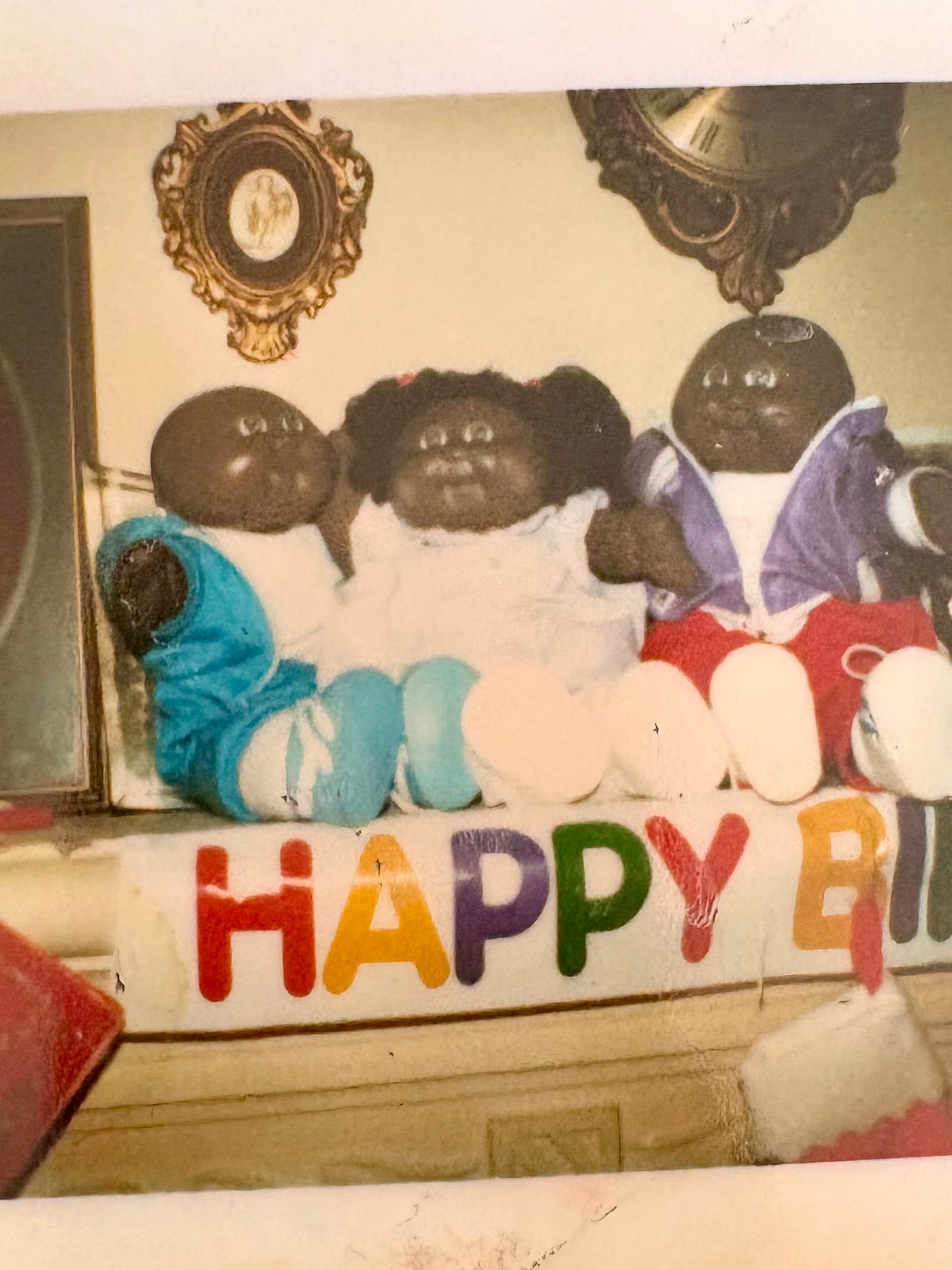
Later, when my nieces were young (and I fully participated right along with them), there was an entire cast of dolls: Al, Joe, White Boy—who was indeed a White baby doll, though his “Christian name” was John—Precious, Krystal, Billy. Each one had a name, a personality, and a presence. And in many ways, those personalities reflected my mother’s own experiences—her siblings, her upbringing in the South, growing up without much materially, but surrounded by love and family.
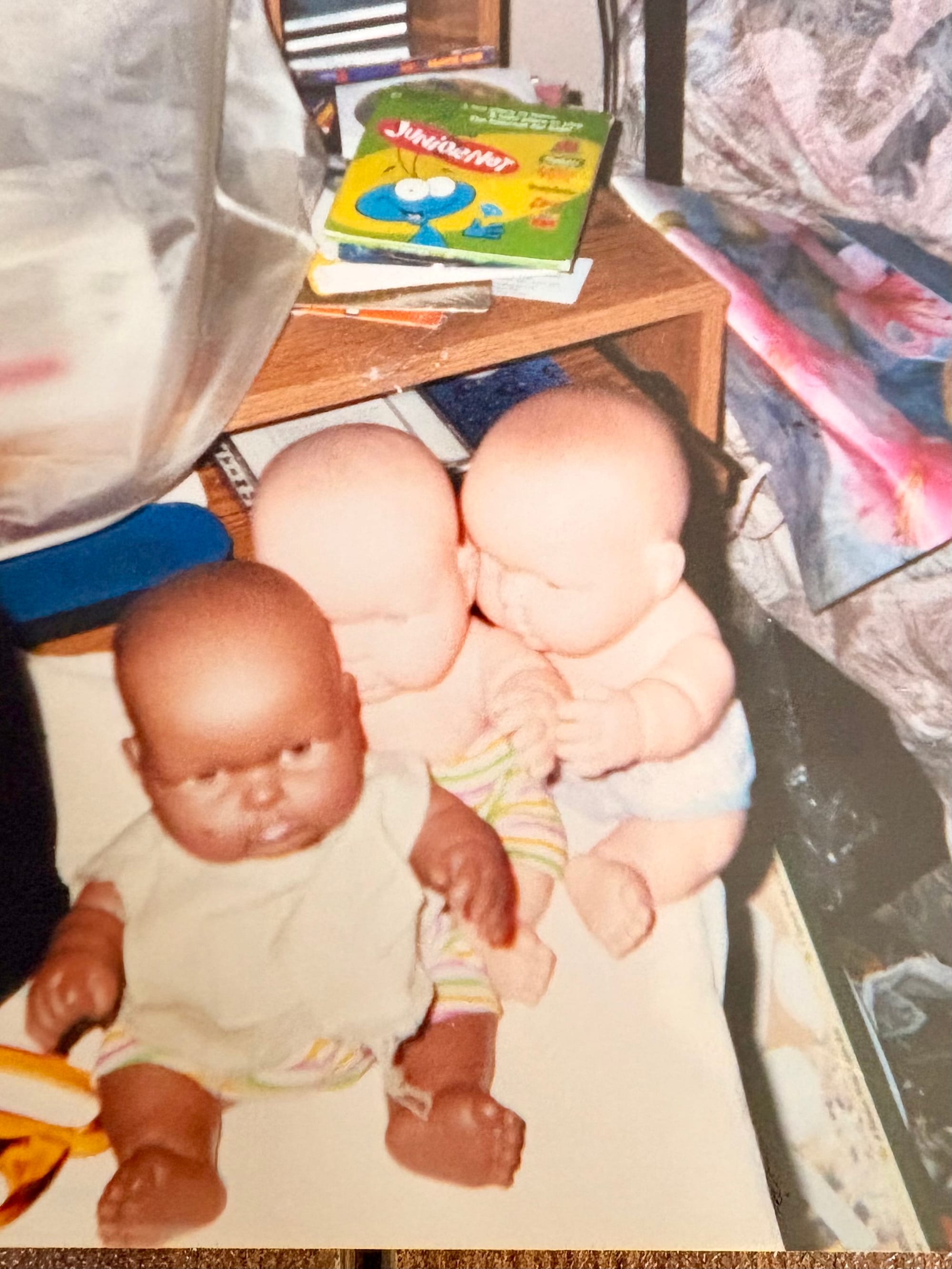
Over time, these dolls became an extension of our family. Not in a way that felt unusual or needed explanation, but in a way that felt completely natural. They weren’t just objects we played with and set aside. They had names, voices, and identities that my mother brought to life with ease. We interacted with them as if they belonged—because, to us, they did. No one questioned it. No one labeled it. We weren’t thinking about psychology or terminology. We were simply relating, imagining, and connecting in the way that felt most natural to us.
Looking back now, I can see that there was something deeper happening in those moments. There was creativity, yes—but also comfort, connection, and healing. In many ways, it was a quiet form of coping that we practiced together without ever needing to name it.
Then Came Samson
So when Samson came into my life, and later into our family, it felt natural to do the same. What we did with him didn’t feel new—it felt familiar. The only difference was that now there was a word for it. Learning the term "anthropomorphism" didn’t introduce a behavior I had to adopt; it gave language to something we had already been doing in our own way for years. With Samson, that expression took on a life of its own.
And beyond the roles we gave him—grandcat and my son—he had a personality and a life that we actively imagined and built around him.
I remember giving Samson a voice—one that felt so natural it became part of how I related to him. Everything Samson “said” ended with the words, “for all of my time…” His grandma was his favorite grandma “for all of his time.” And from there, the stories followed.
At one point, when he turned five, Samson went to kindergarten. He had a whole routine. He went to a school where he sat by the window and learned from birds. On Saturdays, the birds would go shopping. I’ll never forget one day when my mom and I were out and saw a bird sitting on a shopping cart in a parking lot. Without missing a beat, I said, “Well, I guess that must be the bird that’s going shopping,” and we just kept going. No explanation. No questioning. Just shared understanding—and a moment of laughter that made perfect sense to us.
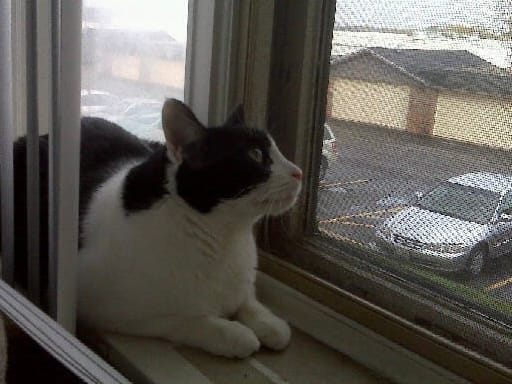
Looking back, I can laugh at how elaborate those stories were, but I also recognize that they weren’t random. From the outside, I can imagine someone looking at us and wondering what in the world we were doing. But from the inside, it made perfect sense. They were an extension of connection—a way of interacting, imagining, and, in some ways, caring. At the time, it was just something we did. Now, I can see it as part of a much larger pattern—one that connects creativity, relationship, and meaning in ways that are easy to overlook if we only look at it from the outside.
So What Is Anthropomorphism, Really?
Anthropomorphism is one way that humans experience the human–animal bond.
At its core, anthropomorphism often shows up in the ways we interpret our animals’ behaviors, assign them personalities, or imagine their inner worlds. What I later came to understand through the literature is that this isn’t just playful or imaginative—it’s actually a common and meaningful way that humans form deeper connections with their animals. Researchers have described anthropomorphism as a process where people project their own hopes, desires, and emotions onto their companion animals, strengthening the bond and making the relationship feel more intimate.
This can take many forms. People create stories about what their animals are thinking or feeling. They assign them distinct personalities. They celebrate birthdays, imagine daily routines, and sometimes build entire narratives around their lives—much like the stories I created with Samson. From a psychological standpoint, this way of relating is not random. It is rooted in how we understand ourselves and others. Anthropomorphism allows us to use our own human experiences as a framework for interpreting the behavior of another being.
More Than Just Imagination
At the same time, anthropomorphism is not as simple as it may seem. While it can deepen connection and enhance the human–animal bond, research also suggests that it often serves as a coping mechanism—particularly during periods of stress or when social support is limited. In that sense, the act of assigning human qualities to an animal is not just about the animal—it is also about the human need for comfort, understanding, and connection. And recently, I have begun to think about whether this truly benefits the animals in our care.
There is also a tension within the research. On one hand, anthropomorphism has been associated with increased feelings of social support and overall well-being. On the other hand, more intense levels may reflect unmet needs or heightened stress. This is where anthropomorphism becomes less of a simple explanation and more of a complex, layered human experience.
And understanding this complexity is essential—especially when the bond is broken.
This is because the extent to which we attribute human qualities to our pets can shape the depth of our attachment. And that attachment is closely tied to the intensity of grief experienced when a companion animal passes away. When an animal is not just seen as a pet but as a friend, a child, or a source of emotional support—and even as having a human-like life, whether imagined or not—it adds meaning to the relationship. And that meaning is part of why the loss can feel comparable to losing a significant human relationship.
Anthropomorphism, in this way, does not just help explain the bond—it helps explain the grief that follows.
What Comes Next
This is where I want to pause—for now.
Because anthropomorphism, as simple as it might sound, is doing more work than we often realize. It shapes how we connect, how we make meaning, and how we experience our relationships with the animals in our lives.
This is Part 1 of a new series.
In the next post, I’ll spend more time exploring how anthropomorphism, attachment, culture, and grief intersect—and why the loss of a companion animal can feel so profound and, at times, so difficult to explain.
Because for all the complexity, I keep coming back to something simple.
I don’t think Samson needed to go to school taught by birds.
But I do think those stories meant something.
To me.
To my mom.
To us.
And maybe that’s the point. 😻


