I Didn't Set Out to Become an Animal Chaplain
An unexpected email during my dissertation journey introduced me to two words I couldn't forget: animal chaplain. I never imagined where they would lead. This is the story of a dissertation, one very good cat, and an unexpected calling.

A Dissertation, a Cat, and an Unexpected Calling
A few days ago, I was ordained as an animal chaplain.
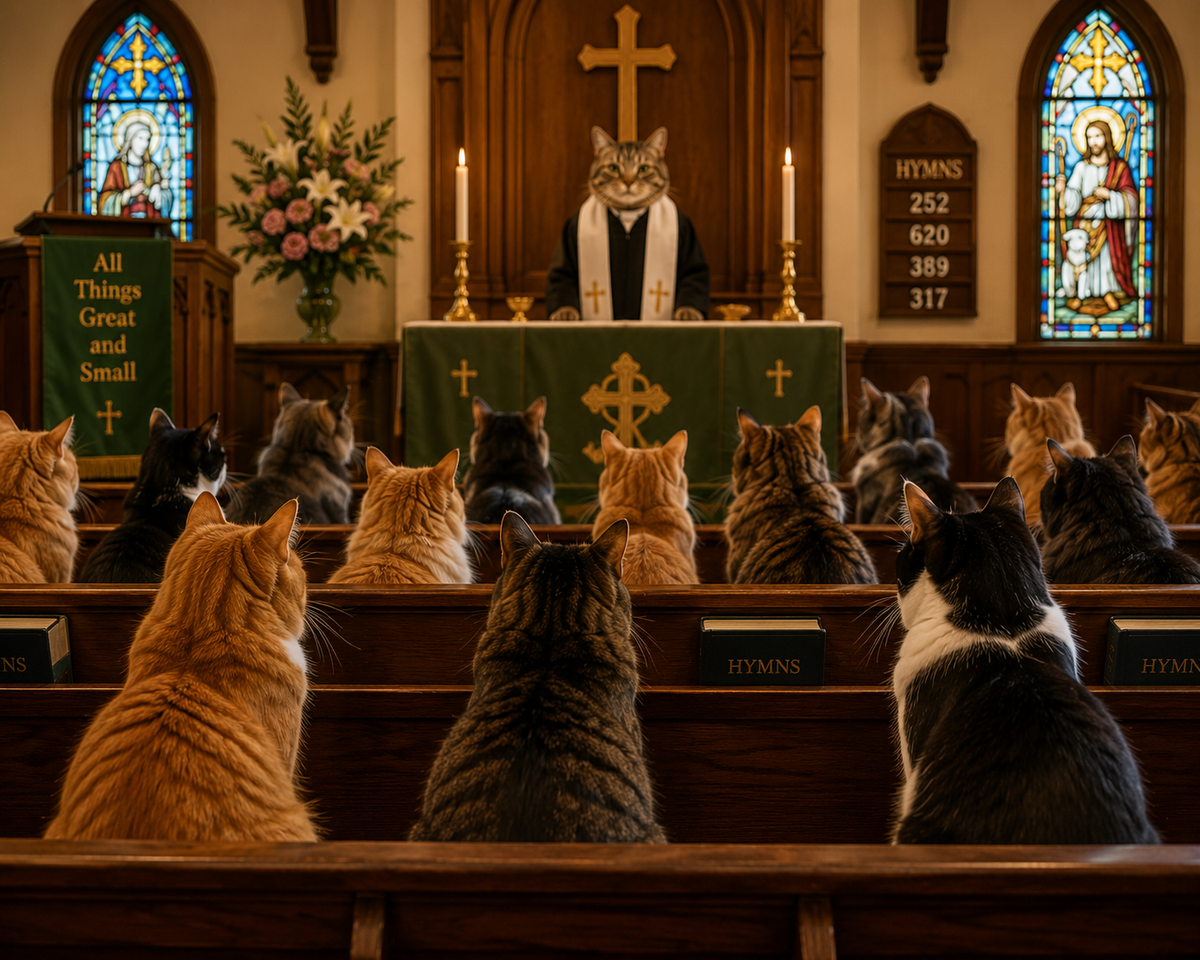
I am sure if you're not familiar with those words, you may have a lot of wonderful questions. When I first shared that I was training to become an animal chaplain with a trusted friend, they wanted to know whether this meant I could now marry animals. Fair question. Personally, I was more prepared to defend the accusation that I might start holding church for cats. That would be a ministry too good to be true.
But in all seriousness, the question I've been asked most—both directly and indirectly—is, Why?
It Started With a Dissertation
My journey to animal chaplaincy had little to do with seeking animal chaplaincy. It starts with my dissertation research exploring the experiences of African American adults grieving the loss of a companion animal.
Back in 2024, I was worried about one thing: finding participants.
I wasn't simply recruiting people who had lost a pet. I was recruiting African American adults who were willing to talk openly about one of the most painful experiences of their lives. My dissertation committee also required that I limit recruitment to several Midwestern states, narrowing an already specific population even further.
There was very little research examining African Americans and pets. That lack of literature was one of the reasons I chose the topic, but it also made recruitment feel like a leap of faith. I had heard stories of doctoral students who reached this stage only to discover they couldn't recruit enough participants, forcing them to change their research questions or redesign their studies altogether. I quietly wondered if that might become my story too.
So I cast a wide net. I shared my recruitment flyer through social media, reached out to organizations working in animal welfare and pet loss support, and asked colleagues and professional contacts to help spread the word. While those efforts brought more than a few imposter participants along the way (a story for another day), they also connected me with people I never would have met otherwise.
One of those connections arrived as a simple email.
Two Words I Couldn't Shake
Someone had come across my recruitment flyer and wanted to help connect me with potential participants. As it turned out, they lived outside the geographic area I was recruiting from, so I thanked them for reaching out and explained that my study was limited to a handful of Midwestern states. If I needed to expand recruitment later, I told them I would keep their information.
Ordinarily, that would have been the end of the story.
But it wasn't.
The person who had reached out had identified themselves as an animal chaplain.
I remember reading those words and thinking, Wait...that's a thing?
At the time, my only experiences with chaplains had been in hospitals during some of the most difficult moments of my life, first before my dad died and then later when my mom died.
Looking back now, I have much more compassion for those chaplains than I did in those moments. They stepped into situations that were already unfolding, carrying the impossible task of offering comfort in the middle of shock and heartbreak. As someone who now studies grief and has been trained in spiritual care, I appreciate just how difficult that work can be.
Even so, chaplaincy wasn't a word I associated with comfort or something I imagined would one day become part of my own story.
When Curiosity Became a Calling
I didn't search for an animal chaplaincy program the day I received that email. I tucked the idea away and returned to what was immediately in front of me—completing my dissertation, navigating my career, and trying to make sense of a season of significant personal and professional transition.
But those two words never really left me.
At the same time, my dissertation was beginning to shape me in ways I hadn't anticipated. Participants spoke about praying for their pets. They wondered whether animals had souls. They described sensing their companion animal's presence after death or finding comfort in the belief that they would one day be reunited. Others talked about how the loss of a companion animal had strengthened their faith, challenged it, or simply caused them to ask questions they had never considered before. Their stories challenged me to think beyond grief as a single event and toward the many ways our relationships with animals influence our lives.
As I began asking myself what came next after the dissertation, I found myself thinking about that email again.
Animal chaplain.
This time, instead of simply wondering whether such a role existed, I started looking into it and discovered that animal chaplaincy wasn't just "a thing." It was an established field of spiritual care that recognized the profound relationships between humans and animals and sought to support those relationships through compassion, presence, ritual, and community.
The more I read, the more I realized I wasn't looking for another credential.
I was looking for language.
Language for work that my research had already begun teaching me to do.
The Night I Said Goodbye to Samson
I also began thinking differently about another experience that had shaped me years earlier: the night I said goodbye to Samson.
Anyone who has experienced the loss of a companion animal knows how quickly those final moments unfold. Even when you know you're making the most compassionate decision, you're often asked to make dozens of other decisions at the same time.
As I held my seventeen-year-old boy in my arms, I remember watching the veterinarian and veterinary staff carry what felt like an impossible number of responsibilities. They were making sure Samson's transition was peaceful and medically appropriate. They were explaining my options, answering questions about cremation and memorial items, navigating paperwork and finances, and somehow trying to care for me through one of the hardest moments of my life. I don't tell this story because I believe anyone failed me. In fact, I believe they did the very best they could under extraordinarily difficult circumstances.
But what if there was room for another kind of presence? Someone whose primary responsibility wasn't medical care or logistics, but simply accompanying people through the emotional and spiritual weight of loving—and saying goodbye to an animal who had become family. Now I can't honestly say that, had an animal chaplain been present that day, I would have responded any differently. Grief has a way of overwhelming us regardless of who is standing beside us.
But I began to understand that animal chaplaincy wasn't about replacing veterinary medicine or fixing grief, but it was about recognizing that moments like these involve far more than medical decisions. They involve a synergy of care through the lens of love, identity, relationships, meaning, and loss.
And through that reflection, I seriously considered that animal chaplain might become part of my own journey.
More Than I Expected
When I found and ultimately began the animal chaplaincy program, honestly, I thought I knew why I was there.
I expected to deepen my understanding of companion animal loss and grief. After all, that was the work I had been immersed in through my research, and I assumed this would simply become another way of supporting people experiencing one of life's most difficult transitions.
I couldn't have been more wrong—in the best possible way.
The curriculum certainly included grief, but it also invited us into conversations about ethics, spirituality, ritual, animal communication, compassion, advocacy, environmental justice, and the many ways humans and animals exist in relationship with one another. It challenged me to think beyond individual moments of loss and to consider the broader interconnectedness of life itself.
Some of those conversations stretched me in unexpected ways. Others affirmed ideas I had already begun exploring through my research. Still others simply encouraged me to sit with questions that didn't have easy answers.
One of the things I appreciated most was that the program never expected everyone to arrive with the same beliefs, experiences, or goals. Some people came as clergy. Others were veterinarians, animal advocates, caregivers, educators, or simply people who felt called to serve animals and the humans who love them. We didn't always agree on everything, but we shared a willingness to learn from one another.
That openness made room for genuine growth.
It also reminded me that education is at its best when it doesn't simply give us answers—it expands the questions we're willing to ask.
The Moment I Knew I Was Somewhere Special
As the months went on, I began to realize that this wasn't simply a program I was completing. It was a community I was becoming part of.
The curriculum was rigorous. We studied grief, ethics, spiritual care, ritual, and animal advocacy. We built our own community with practicum partners to work through real-life scenarios we might encounter as animal chaplains. We were challenged to create blessings, rituals, memorial practices, and other experiences that invited us to think creatively about what compassionate presence could look like in different situations.
Those assignments stretched me.
But the moment I knew I was somewhere special had nothing to do with an assignment.
It was Samson.
One of our opportunities involved sharing about an animal who had deeply shaped our lives. As I prepared to talk about Samson, I realized something that surprised me.
I had never really told his story.
Not like this.
Not as a eulogy.
Not as a tribute.
Not in a space where everyone in the room immediately understood that the love I felt for him needed no explanation or justification.
For the first time, I was invited to speak about Samson's life the way we so often speak about the people we love—with gratitude, tenderness, laughter, tears, and deep appreciation for the ways he had changed me.
It was profoundly healing.
Ironically, my own research had explored the ways companion animal grief is so often unseen or misunderstood. Yet it wasn't until that moment that I realized I had never fully been given permission to tell Samson's story in that way either.
When I finished, my classmates didn't see "the researcher."
They saw Samson's mom.
And somehow, that meant everything.
Carrying It Forward
The program concluded with a capstone project—a chance to bring together everything we had learned and imagine how we might carry it into the communities we serve.
Interestingly, I chose not to focus on grief...but life.
I developed a pet blessing at my local church, creating an opportunity to celebrate the animals who share our lives while also integrating my own faith tradition with what I had learned through the program. It reminded me that animal chaplaincy isn't only about helping people say goodbye. It is also about honoring the relationships we have with animals while they are still here.
Stewards of Creation Pet Blessing and Sermon
That experience captured something I had been learning throughout the program. Animal chaplaincy is not simply about responding to moments of loss. It is about cultivating compassion, presence, and care across the many ways humans and animals share life together.
As I look ahead, people will probably continue asking me the same question they ask whenever I earn another degree or certification:
"So...what are you going to do with that?"
It's not necessarily about doing, but more about alignment and integration.
How does this experience deepen the work I'm already doing?
How does it make me a better researcher?
A better educator?
A better advocate?
A better human being?
Animal chaplaincy doesn't replace any of those parts of my life. It helps bring them together.
As Heart & Science continues to grow, I can already see new possibilities emerging—from educational resources and workshops to rituals, blessings, and memorial experiences that honor the extraordinary relationships people share with the animals they love. Exactly what that will look like is still unfolding, and I'm comfortable letting it unfold in its own time.
For now, I'm simply grateful that one unexpected email led me down a path I never expected to travel.
Animal chaplain.
If you are interested in animal chaplaincy, visit Animal Chaplaincy Training at Compassion Consortium for more information.


